Welcome to Admizion #1 Your Gateway to Global Education – Apply, Study, Succeed!

MBBS in India is one of the world’s most competitive and well-regarded undergraduate medical programs. With a long history of medical education, India provides a thorough blend of theoretical knowledge and significant clinical experience, successfully preparing students for a medical profession with global relevance.
Some of the top medical schools and reputable government hospitals in the world are located in India. The National Medical Commission (NMC) strictly regulates the country’s medical education system, guaranteeing a dedication to excellence, uniformity, and conformity to international norms. Early in their training, students gain a great deal from the mentoring of highly qualified faculty, a strong infrastructure, and priceless opportunity to interact with a wide range of clinical patients.
In India, the duration of the MBBS program is 5.5 years. This entails four and a half years of academic study, followed by a required one-year rotating internship in a variety of medical facilities.
To be eligible for the MBBS program in India, prospective students must fulfill the following criteria:
The NEET (National Eligibility cum Entrance Test) is used to centralise admissions to MBBS programs in India. Through specific state and national counselling portals, students can apply to government, private, or deemed universities based on their NEET scores.
(Note: Please be aware that fees can vary significantly based on the specific location, institutional category, and the particular institution.)
Indian MBBS graduates have plenty of exciting professional opportunities. They can:
Get a postgraduate degree in medicine, such as an MD (Doctor of Medicine), MS (Master of Surgery), or DNB (Diplomate of National Board).
Serve in both public and private healthcare organisations.
Become an independent doctor or surgeon.
Enter the fields of public health, education, or research.
To practise overseas, get ready for foreign medical licensure exams such as the USMLE (United States Medical Licensure Examination) or PLAB (Professional and Linguistic Assessments Board).
Choosing to pursue an MBBS degree in India represents a judicious and impactful decision for students who possess a strong passion for serving in the healthcare domain. Combining academic excellence, practical training, and relatively affordable education, India continues to be a significant contributor to the global pool of highly skilled medical professionals.
The choice depends on factors such as budget, NEET score, career goals, college availability, and preferred study destination. Both options have advantages depending on the student’s profile.
Candidates must be at least 17 years old by the prescribed date of the admission year.
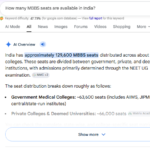
The number of MBBS seats changes every year as new medical colleges are approved. Admissions are conducted through NEET counselling based on seat availability.